
Nutrition
Your Smartwatch Says Your "Recovery Score" Is 42. Should You Panic?
Smartwatches now track HRV, sleep and recovery scores. Learn what these numbers actually mean and how to use them without obsessing.
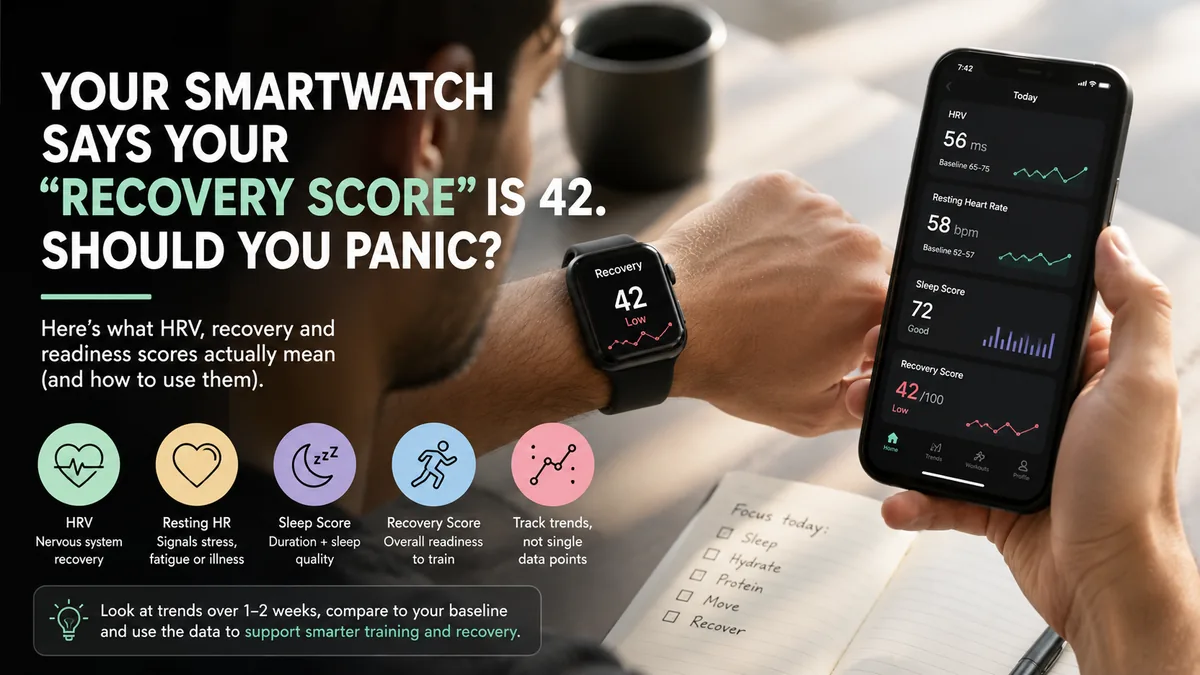
You wake up, check your wrist, and see a recovery score, an HRV number and a readiness percentage before you've even had your coffee. Wearables have moved far beyond step counts — and most people have no idea what the numbers actually mean or whether to act on them.
The number matters less on its own and more as a trend against your personal baseline, not a fixed target to hit.
Why these numbers are suddenly everywhere
Wearable technology has expanded from counting steps to measuring HRV, sleep stages, skin temperature, and even blood oxygen — and manufacturers now package these into simple "readiness" or "recovery" scores. This appeals to a broader shift in fitness culture: less about chasing a single workout, more about managing overall recovery and long-term function.
What each common metric roughly tells you
HRV (heart rate variability)
Reflects nervous system recovery. Trending downward over several days can suggest accumulated fatigue, poor sleep or illness onset.
Resting heart rate (RHR)
A resting heart rate noticeably higher than your personal average for a few days can also signal under-recovery, dehydration or an oncoming illness.
Sleep score
Combines duration and estimated sleep stages. Useful as a rough guide, but wearables estimate sleep stages indirectly — treat the score as directional, not clinically precise.
Recovery / readiness score
Usually a blend of HRV, RHR, sleep and sometimes training load, packaged into one number to suggest whether to push hard or go easy that day.
How to actually use these numbers
- Look at trends over 1–2 weeks, not single-day readings. One low score after a late night isn't a red flag.
- Compare against your own baseline, not a "normal" number online — HRV especially varies hugely between individuals.
- Use a consistently low trend as a nudge to prioritise sleep, hydration, protein and lighter training — not as a diagnosis.
- Don't skip movement entirely because of one low score. A recovery walk is usually fine even on an "off" day.
When the numbers matter more
A sustained, multi-day drop in HRV or recovery score, especially alongside fatigue, poor sleep or unusual soreness, is a reasonable signal to scale back training intensity and focus on sleep and nutrition for a few days.
The bottom line
Your smartwatch isn't diagnosing you every morning — it's estimating a trend. Don't let one low score derail your day or one high score push you into overtraining. Watch the pattern over weeks, support it with consistent sleep and protein intake, and let the number inform your training, not dictate it.
Use Eleviy to track how your sleep, meals and training load line up over time, so recovery trends make more sense alongside what you're actually eating.
This article is for general education and is not personalised medical advice. Consumer wearables estimate physiological signals and are not medical-grade diagnostic devices.