
Nutrition
Can AI Really Count Calories From a Food Photo? What Meal Scanners Get Right—and Wrong
Learn how AI meal scanners estimate calories from food photos, what they identify accurately, where errors occur and how to improve each scan.
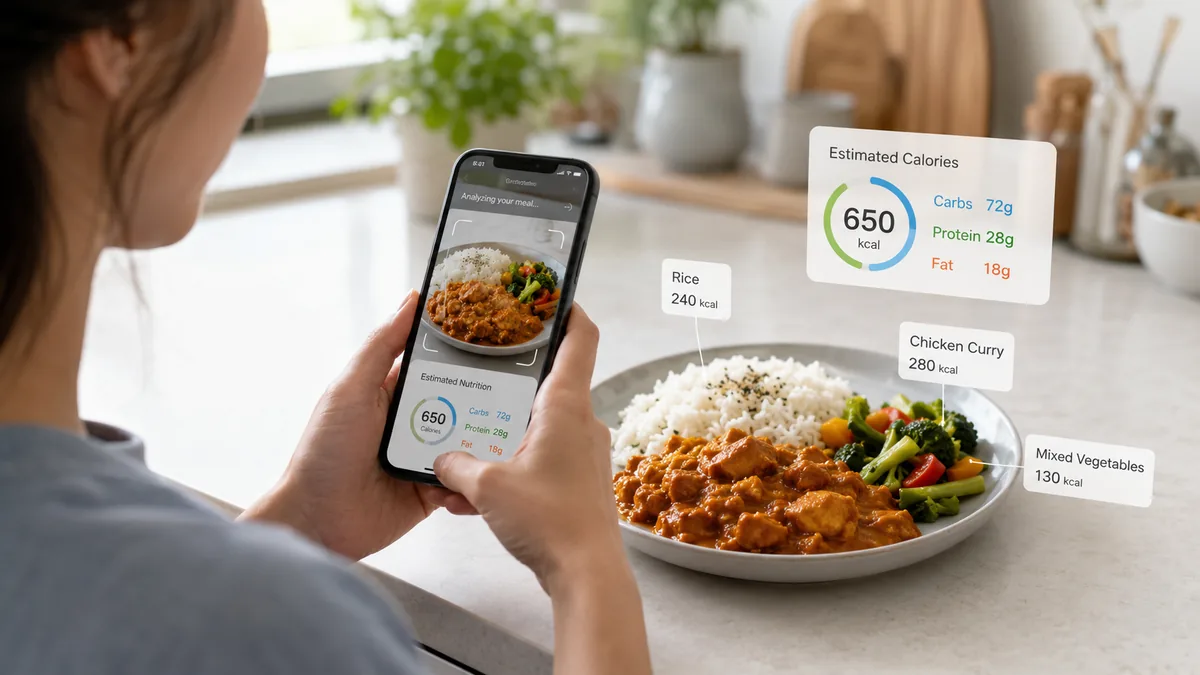
It uses the food photo to identify visible foods, estimate their portions and match them with nutritional values stored in a food database. The final calorie number is therefore an estimate, not a laboratory measurement.
Current systems can be useful for quickly logging meals and recognising clearly visible foods. Their biggest weaknesses are portion size, hidden ingredients, cooking methods and mixed dishes.
The most practical approach is to let the scanner create the first estimate, then correct the food names, quantities and ingredients before saving the meal.
How does an AI meal scanner work?
Most photo-based meal scanners perform three main tasks:
- Food recognition: Identify the foods visible in the image.
- Portion estimation: Estimate the amount or weight of each food.
- Nutrition matching: Find comparable foods in a nutrition database and calculate estimated calories and macros.
Research systems may also use depth sensors, multiple camera angles, ingredient databases and user-entered descriptions to improve the result. For example, the Nutrition5k research dataset contains more than 5,000 plates photographed through multiple side-angle videos and overhead depth images, together with the measured weight and nutrition of each ingredient. (GitHub)
A consumer app working from one ordinary smartphone photo usually has much less information.
What meal scanners get right
1. Recognising clearly visible foods
AI can often identify foods with distinctive colours, shapes and textures.
Examples may include:
- A banana
- Boiled eggs
- Plain rice
- Roti
- Grilled chicken
- Broccoli
- Idli
- A visible bowl of dal
In one evaluation of commercial nutrition apps, some AI-enabled apps correctly recognised a high proportion of the food images tested. However, recognising the food did not guarantee an accurate calorie calculation. (MDPI)
2. Creating a faster first draft
Taking a photograph can reduce the effort required to start a food log.
Instead of manually searching for every item, the scanner may separate a plate into rice, dal, vegetables and curd. The user can then review the suggested foods rather than building the entire meal from zero.
This makes photo scanning particularly useful for people who stop tracking because manual logging feels repetitive.
3. Estimating simple, separated plates
A meal scanner generally has a better chance when:
- The foods are separated
- The entire plate is visible
- Lighting is clear
- The photo shows height as well as surface area
- The meal uses common ingredients
- The serving container is easy to understand
A recent study on photo-based portion estimation found that both food type and camera angle affected accuracy. For cooked rice, accuracy was higher from a 45-degree angle than from directly overhead, and combining multiple angles improved the result further. (E-NRP)
What meal scanners get wrong
1. Hidden oil, ghee, butter and sugar
A photo cannot reliably show how much oil was absorbed into a curry or how much ghee was added to khichdi.
It may also miss:
- Butter inside mashed potatoes
- Sugar in tea or coffee
- Cream in gravy
- Coconut milk in curry
- Mayonnaise in a sandwich
- Honey mixed into curd
- Oil used while preparing dosa or paratha
Two visually identical meals can therefore contain different numbers of calories.
2. The exact portion size
A two-dimensional photograph does not always show the height, depth or weight of food.
A bowl may contain 150 grams or 300 grams of rice while appearing similar from above. Deep bowls, overlapping foods and partially hidden portions make the problem harder.
Photo-based portion research has found major differences between foods. In one study, rice portions were estimated relatively well from suitable angles, while soup remained difficult and achieved less than 50% accuracy even when several viewing angles were combined. (E-NRP)
3. Mixed Indian dishes
Indian meals can be particularly challenging because one visible dish may contain many ingredients.
For example, a scanner looking at paneer curry may not know:
- Whether the paneer is full-fat or reduced-fat
- How much paneer is actually present
- Whether the gravy contains cream or cashews
- How much oil was used
- Whether sugar was added
- Whether the portion is homemade or restaurant-style
A 2024 evaluation found that automated calorie estimates were especially unreliable for mixed and culturally diverse meals, even when the apps successfully recognised visible food components. (MDPI)
Training data can also affect performance. The Nutrition5k researchers explicitly note that their dataset was collected in selected California cafeterias and does not represent every cuisine. (GitHub)
4. Cooking methods
AI may correctly identify “chicken” but fail to distinguish accurately between:
- Grilled chicken
- Deep-fried chicken
- Butter chicken
- Chicken tikka
- Chicken cooked with skin
- Chicken in a coconut-based curry
The food name may be correct while the calorie estimate is not.
5. Foods hidden underneath other foods
A photo only shows what the camera can see.
Rice underneath curry, cheese inside a sandwich, filling inside a paratha and dressing beneath a salad may be missed or underestimated.
The scanner may also count food placed on the plate even when part of it is left uneaten.
How accurate are AI calorie scanners?
There is no single accuracy percentage that applies to every scanner, food and situation.
Performance depends on:
- The AI model
- Its training data
- The nutrition database
- Photo quality
- Camera angle
- Food complexity
- Portion-estimation method
- Whether the user provides additional information
A 2025 study evaluating a vision-language model found considerable errors when estimating meal weight and energy from images. Another research system, DietAI24, improved nutritional estimation by combining visual AI with retrieval from an established food database, reducing mean absolute error substantially compared with tested baselines. However, it remains a specialised research framework rather than proof that every consumer scanner is clinically precise. (PubMed)
The appropriate conclusion is not that meal scanners are useless. It is that their results should be treated as editable estimates.
How to improve your meal scan
Take the photo at an angle
A photograph taken at approximately 45 degrees can show both the surface and height of the food better than a completely overhead photograph.
Where supported, add a second angle for deep bowls, rice, curries and irregularly shaped foods. Multiple viewing angles improved portion estimation for several food types in controlled research. (E-NRP)
Keep the entire plate visible
Avoid cropping the plate or hiding bowls behind one another. Use good lighting and photograph the meal before beginning to eat.
Separate the meal components
Keep rice, curry, vegetables, salad and curd visibly separated where practical. This helps the scanner identify each component rather than treating the plate as one unknown mixed dish.
Include a size reference
A standard spoon, fork or known plate size can provide useful scale. Some research systems use depth information or reference objects because pixels alone do not reveal an item’s true dimensions. (GitHub)
Correct the estimate before saving
Check:
- Food names
- Number of rotis or idlis
- Cooked serving weight
- Oil and ghee
- Sauces and chutneys
- Drinks
- Restaurant versus homemade preparation
For calorie-dense ingredients such as oil, paneer, nuts and spreads, weighing or measuring the portion remains more reliable than expecting the photograph to determine it.
Should you use a meal scanner for weight loss?
A meal scanner can be useful when its convenience helps you log more consistently.
It may help you:
- Notice portion patterns
- Compare similar meals
- Track approximate protein and calories
- Remember meals that would otherwise go unlogged
- Review changes across days and weeks
Do not judge your progress from whether one photographed meal was recorded as 480 or 530 calories. Look at longer-term patterns and correct obvious errors.
Photo estimates should not replace professional dietary assessment when precise nutrition information is medically important. Incorrect nutritional values can be significant in clinical research and personalised dietary treatment. (Nature)
Frequently Asked Questions
Can AI recognise Indian food from a photo?
It may recognise common dishes, but accuracy varies. Mixed curries, regional recipes and visually similar dishes are more difficult, particularly when the training data does not represent the cuisine well.
Can an AI scanner detect cooking oil?
Usually not accurately. Visible oil may influence the estimate, but oil absorbed into food cannot be reliably measured from appearance alone.
Is photo scanning better than manual tracking?
It is generally faster, but it is not automatically more accurate. The best method combines AI detection with user review and correction.
Can an AI scanner calculate protein and macros?
It can estimate them after identifying the food and portion. An incorrect food or portion estimate will also produce incorrect protein, carbohydrate and fat values.
Should I weigh my food as well?
You do not need to weigh every meal permanently. Measuring calorie-dense foods and frequently eaten portions for a short period can help you correct the scanner and understand realistic serving sizes.
The bottom line
AI meal scanners can recognise food and produce useful calorie estimates, but they do not directly count the calories inside a meal.
They work best with:
- Clearly visible foods
- Separated meal components
- Standard portions
- Good lighting
- Multiple angles or size references
- User corrections
They struggle most with:
- Hidden oil and ingredients
- Mixed dishes
- Deep bowls
- Restaurant recipes
- Unfamiliar regional foods
- Overlapping or partially hidden portions
Use the scan as a starting point, not an unquestionable answer.
With Eleviy, users can scan a meal, review the detected foods, adjust portions and ingredients, and use the result to understand their eating patterns over time.
This article is for general education. Photo-based calorie estimates are not medical measurements or personalised nutritional prescriptions.
References
- GitHub - google-research-datasets/Nutrition5k: Detailed visual + nutritional data for over 5,000 plates of food. · GitHub
- Evaluating the Quality and Comparative Validity of Manual Food Logging and Artificial Intelligence-Enabled Food Image Recognition in Apps for Nutrition Care
- www.e-nrp.org
- Evaluating the Quality and Comparative Validity of Manual Food Logging and Artificial Intelligence-Enabled Food Image Recognition in Apps for Nutrition Care
- Performance Evaluation of 3 Large Language Models for ...
- DietAI24 as a framework for comprehensive nutrition estimation using multimodal large language models | Communications Medicine