
Nutrition
20-Minute Home Workout for Beginners: A Complete 4-Week No-Equipment Plan
Start exercising at home with this progressive four-week beginner workout plan. Each 20-minute session requires no gym equipment.
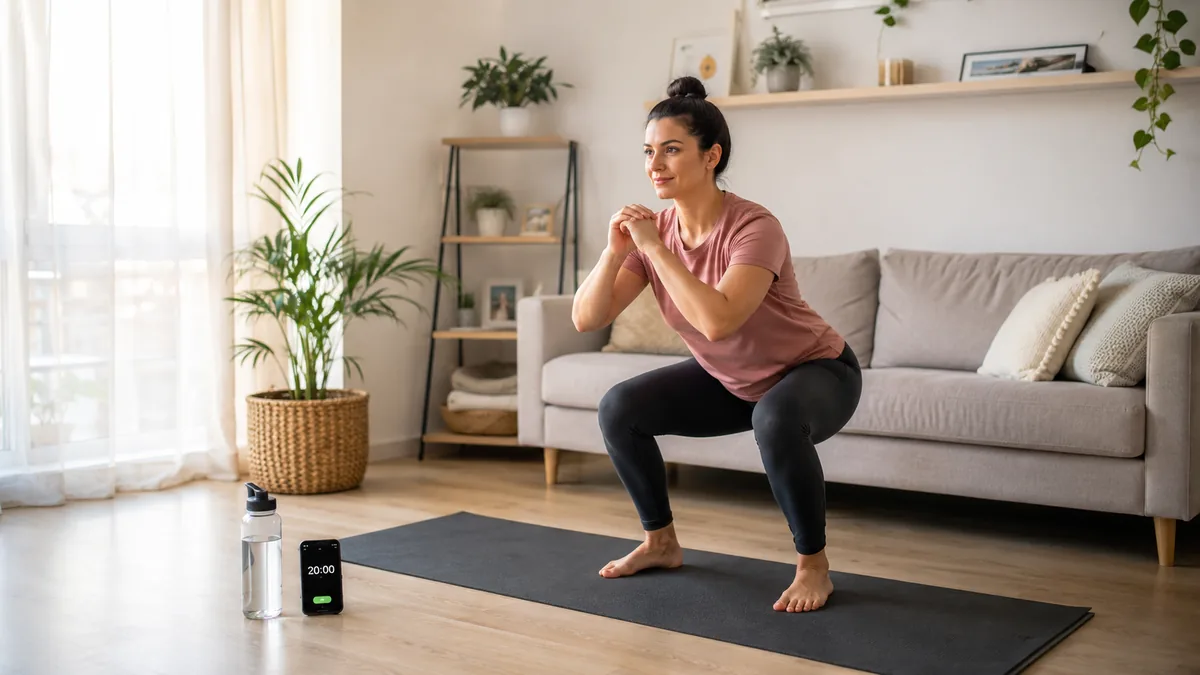
Each session contains:
- A three-minute warm-up
- Two rounds of seven bodyweight exercises
- A three-minute cool-down
The exercises remain the same for four weeks, but your working time gradually increases. This allows you to improve your fitness without immediately adding difficult movements or long workouts.
This plan is a starting point—not the full amount of weekly activity ultimately recommended for adults. Public-health guidance recommends progressing towards 150–300 minutes of moderate aerobic activity per week and completing muscle-strengthening activities on at least two days. However, any activity is better than none, and inactive beginners should start with manageable amounts before gradually increasing them. (World Health Organization)
Your weekly schedule
| Day | Activity |
|---|---|
| Monday | 20-minute home workout |
| Tuesday | Easy walk or rest |
| Wednesday | 20-minute home workout |
| Thursday | Easy walk or rest |
| Friday | 20-minute home workout |
| Saturday | Optional walk, stretching or recreational activity |
| Sunday | Rest |
Keep at least one day between workouts during the first four weeks. Light walking is acceptable on recovery days if you feel comfortable.
The complete 20-minute workout
Three-minute warm-up
Perform each movement for 60 seconds:
- March in place: Swing your arms naturally and gradually lift your knees higher.
- Side steps with arm circles: Step gently from side to side while circling your arms.
- Hip hinges: Push your hips backwards with a neutral back, then return to standing.
Begin slowly and gradually increase your movement. Warming up prepares the body for more demanding exercise and may reduce injury risk. (nhs.uk)
Main circuit: seven exercises
Complete all seven exercises in order. Rest only during the scheduled rest periods. After exercise seven, return to exercise one and repeat the circuit.
1. Sit-to-stand or bodyweight squat
Stand with your feet approximately shoulder-width apart.
Push your hips backwards, bend your knees and lower yourself under control. Stand by pressing through your feet.
Easier option: Sit down on a stable chair and stand back up, using your hands for support only when necessary.
Main areas: Thighs, glutes and hips.
2. Wall press-up
Place your hands against a wall at chest height and slightly wider than your shoulders.
Keep your body straight, bend your elbows and bring your chest towards the wall. Push yourself back to the starting position.
Move your feet farther from the wall when you are ready for more difficulty.
Main areas: Chest, shoulders and arms.
Both sit-to-stands and wall press-ups are recognised beginner strength exercises that can be progressed gradually. (nhs.uk)
3. Alternating reverse step-back
Stand upright and step one foot backwards.
Bend both knees slightly, then push through your front foot to return to standing. Alternate legs.
Easier option: Hold a wall or stable chair for balance and make the step smaller.
Main areas: Thighs, glutes and balance.
4. Glute bridge
Lie on your back with your knees bent and feet on the floor.
Press through your feet and lift your hips until your body forms a comfortable line from your shoulders to your knees. Lower slowly.
Avoid pushing the movement into your lower back.
Main areas: Glutes, hips and core.
5. Bird-dog
Begin on your hands and knees.
Extend one arm forwards and the opposite leg backwards without twisting your hips. Return slowly and change sides.
Easier option: Move only one arm or one leg at a time.
Main areas: Core, back and balance.
6. Low-impact step jack
Step your right foot to the side while raising both arms. Return to the centre and repeat with your left foot.
Easier option: March in place.
Harder option: Increase your speed while keeping the movement controlled.
Main areas: Cardiovascular fitness and coordination.
During the faster exercise, aim for an effort where you can talk but would find singing difficult. This is a practical indicator of moderate intensity. (CDC)
7. Prone W raise
Lie face down with your forehead resting lightly on a folded towel.
Bend your elbows so your arms form a “W.” Gently lift your hands and elbows away from the floor while drawing your shoulder blades together. Lower slowly.
Keep the movement small and avoid lifting your head excessively.
Main areas: Upper back and rear shoulders.
The four-week progression
Each exercise occupies one minute. The working and resting periods change each week.
| Week | Work | Rest | Rounds | Total circuit time |
|---|---|---|---|---|
| Week 1 | 30 seconds | 30 seconds | 2 | 14 minutes |
| Week 2 | 35 seconds | 25 seconds | 2 | 14 minutes |
| Week 3 | 40 seconds | 20 seconds | 2 | 14 minutes |
| Week 4 | 45 seconds | 15 seconds | 2 | 14 minutes |
Week 1: Learn the movements
Move slowly and concentrate on control.
Use the easiest variation whenever necessary. Finishing every repetition is less important than maintaining a comfortable range of motion.
Week 2: Build consistency
Increase the working time by five seconds.
Try to reduce unnecessary pauses, but continue using modified exercises when your form begins to change.
Week 3: Increase your effort
The shorter rest periods should make the circuit feel more demanding.
Progress only one element at a time. For example, move farther from the wall during press-ups or squat slightly lower—not both during the same session.
Week 4: Complete the full progression
Work for 45 seconds at each station.
You should feel challenged near the end of each interval while remaining able to perform controlled repetitions. After week four, repeat the week, add repetitions or progress selected exercises instead of immediately increasing every exercise.
Three-minute cool-down
Perform each movement gently for approximately 30 seconds per side:
- Slow march followed by relaxed breathing
- Standing calf stretch
- Front-of-thigh stretch or seated hamstring stretch
- Chest and shoulder stretch
Allow your breathing to settle gradually. Do not force a stretch or bounce at the end of your range. NHS exercise guidance recommends cooling down gradually following a workout. (nhs.uk)
How hard should the workout feel?
Use a simple one-to-ten effort scale:
- Weeks 1–2: Approximately 4–6 out of 10
- Weeks 3–4: Approximately 5–7 out of 10
- Avoid: Exercising at maximum effort
Muscle fatigue and heavier breathing are expected. Sharp pain, chest discomfort, faintness or extreme shortness of breath are not.
Stop exercising and seek appropriate medical help if you experience chest pain, dizziness, faintness, unusual breathing difficulty or another concerning symptom. People who have not exercised recently should start slowly and discuss exercise with a healthcare professional when they have relevant health concerns. (MedlinePlus)
How to make the plan support weight loss
This workout can increase activity and help build strength, but a 20-minute session does not automatically create weight loss.
For better results:
- Complete all three weekly sessions.
- Add comfortable walking on non-workout days.
- Maintain a sustainable calorie deficit where weight loss is the goal.
- Eat sufficient protein and balanced meals.
- Track progress across several weeks.
- Sleep and recover adequately.
Gradually add walking until your total weekly activity moves closer to public-health recommendations. Activity can be divided into smaller sessions rather than completed all at once. (CDC)
Frequently Asked Questions
Is 20 minutes enough for a beginner workout?
Yes. Twenty minutes can be a practical starting point, particularly for someone who is currently inactive. Consistency and gradual progression matter more than beginning with a long, exhausting session.
Do I need to complete the workout every day?
No. Complete it three times per week and use the days between sessions for recovery, walking or light mobility.
What if I cannot perform all the exercises?
Use the easier variation, reduce your range of motion or take additional rest. A beginner plan should match your current ability rather than force you to keep pace with someone else.
Will this workout build muscle?
Bodyweight exercises can help beginners develop strength and muscular endurance. Continued progress eventually requires harder variations, additional repetitions or external resistance.
Can I repeat the plan after week four?
Yes. Repeat week four until it feels manageable, then progress individual exercises. You could move from wall press-ups to countertop press-ups, increase squat depth or slow the lowering phase of each repetition.
Do I need a fitness mat?
No. A carpet, folded towel or other comfortable non-slip surface can be used for floor exercises.
The bottom line
A successful beginner workout does not need expensive equipment or an hour of free time.
Start with:
- Three 20-minute sessions per week
- Seven simple full-body movements
- Easier variations where necessary
- Gradually longer working intervals
- Recovery days between workouts
Complete the movements with control and progress only when your current version feels comfortable.
Use Eleviy to plan workouts, track completed sessions, monitor daily activity and combine your exercise progress with nutrition and weight-management goals.
This workout is for general education and is not personalised medical, rehabilitation or exercise advice.